Stephanie
Being authentic is about being entirely relaxed in the seat of who you are. The amount of stimulation now-a-days is overwhelming to try and filter through and keep a grasp on your sanity. Amidst all the noise, how can you unwind and uncover your authentic self?
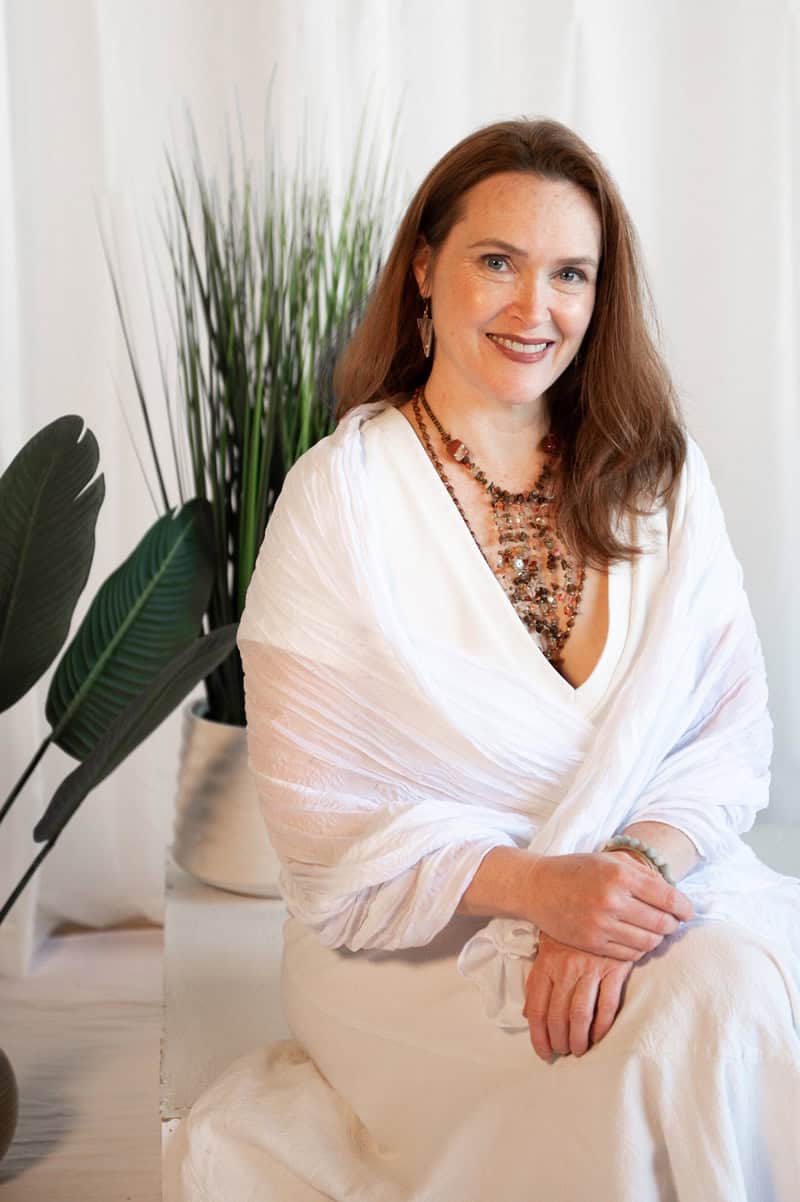
Stephanie Heidemann, Vocalist
- Teacher | Visionary | Music Therapy Pioneer
- Writer
- Bodyworker
- Voice Coach
- Musician
Originally from Detroit, Michigan, Stephanie Heidemann was raised in Venezuela, Australia, Germany and the U.S. Stephanie studied classical piano through childhood, and voice with Brenda Boozer (Metropolitan Opera). She toured nationally with world music a cappella quartet, “VIDA” (IMG-Artists) from 1994-2001, was lead vocalist for The Resonance Project, and has recorded/collaborated with many artists (world, folk, R&B, new age).
Her first solo album, The Cantiga Project, a tribute of 13c Spanish devotionals, was highlighted on NPR’s All Songs Considered. She is currently working on her second album, Starseed in Brown County, Indiana.
As a modern-day-mystic, Stephanie is the pioneer of an expressive arts therapy modality called Authentic Voicework®: Yoga of the Voice and teaches workshops and retreats regularly. She has led workshops as extensively as Sweden and Peru and is working towards her MA in Clinical Mental Health Counseling & Music Therapy at Lesley University.
Artist Statement — Stephanie Heidemann
I sing to
reach the place before language — the ancestral, even primordial layer where
sound itself does the work that words can’t. My practice is built on ancient
musics: modal scales, drones, and vocal traditions that predate the concert
hall, music that was never meant to be observed from a distance. I’m not
interested in performing under glass. I want the room to enter the sound with
me.
This comes
from my own experience of meditative, ecstatic states — not stillness as
absence, but stillness as ignition. The kind of quiet that raises the hair on
your arms because something ancient in you recognized the tone. I chase that
feeling as a singer, and I build performances to bring audiences into that
space alongside me: shared trance, not the distance of spectators and artist as
“other.”
I return
again and again to the mystics — Hildegard of Bingen above all — because her
music does exactly this. It doesn’t ask to be admired; it asks to be entered.
Her scales and modes still carry that charge centuries later, and I’ve found
the same resonance in vocal traditions from around the world: different
lineages, the same primordial frequency, capable of pulling strangers into a
single, unified listening.
That’s the
heart of what I do — using the voice, ancient modes, and altered states to
dissolve the distance between performer and audience, and to invite a room full
of people, however briefly, into a feeling
of magic together.